
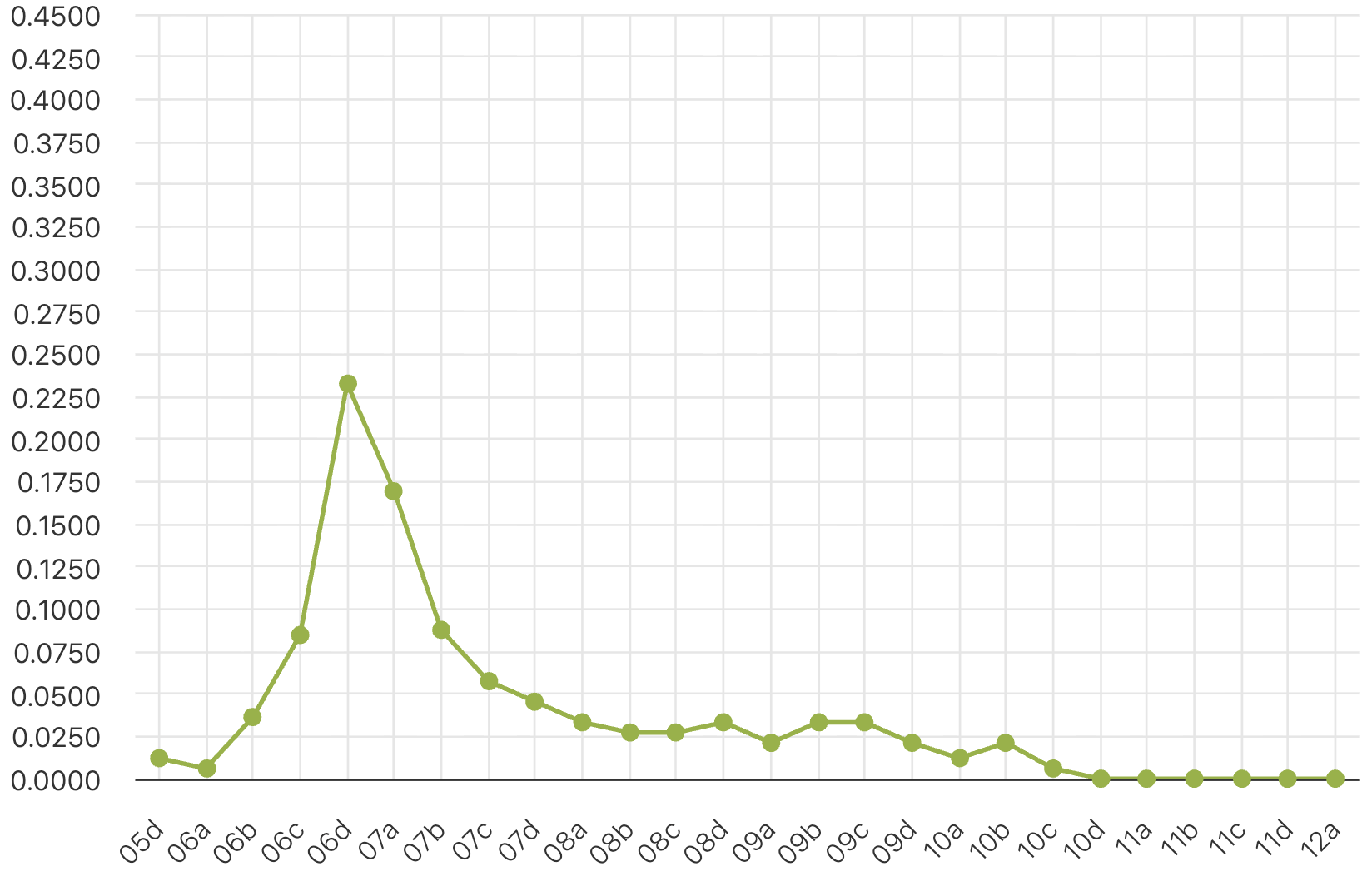
Density distribution 1
This is a typical distribution for a CLAS score of 1028, showing densities that, for the most part, gradually decline between 07c and 10b. This pattern is associated with high logical coherence and continued development in adulthood.
“They have no clue. They're just confused. They don't know what to do. Often, how I think the mind deals with confusion is like, ‘Let go of it. Forget about it for a while.’ Letting it go relaxes the mind.”
CLAS score = 1028, FIT = 92.64%, true score range = 10 points
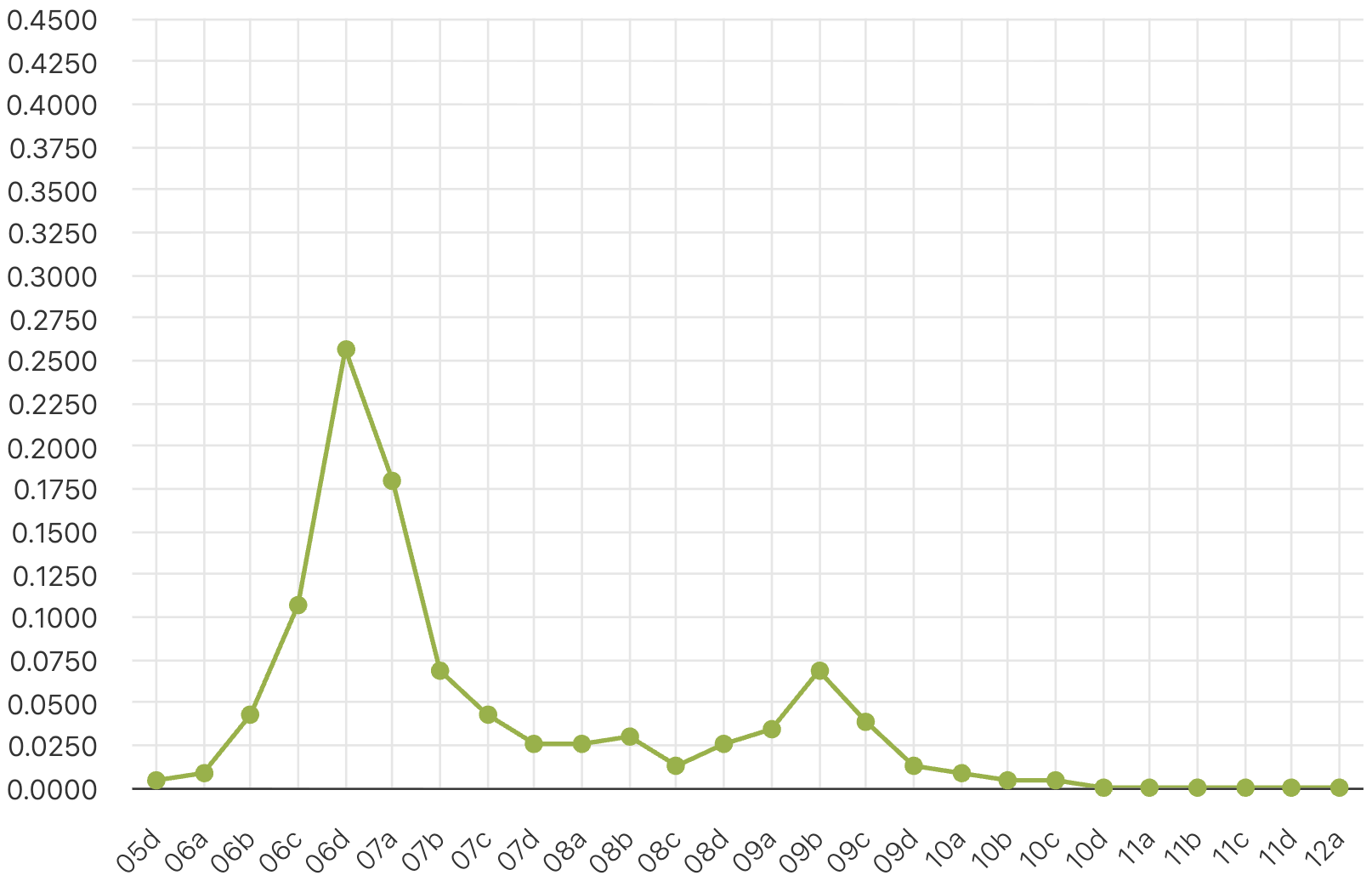
Density distribution 2
This is a typical distribution for a CLAS score of 1028, showing densities that, for the most part, gradually decline between 07c and 10b. This pattern is associated with high logical coherence and continued development in adulthood.
“I don't believe in suicide, I think it's a real coward's way out. You leave a lot of pain behind—especially if you have family—and unresolved questions, and I don't think that's appropriate.”
CLAS score = 1028, FIT = 94.95%, true score range = 10 points
Density distribution 3
This is a less typical distribution for a CLAS score of 1028, showing densities that decline at 08c, then peak strongly at 09b before sharply declining at 09c and 09d. We have dubbed this pattern memorize & forget or sacrificial learning. This pattern is associated with rote learning, low logical coherence, and early flattening of the developmental curve.
“You can never trust information until it is solved or situated in a way you will understand. Some accusations are never correct. That's why we will never know what's real and what isn't.”
CLAS score = 1028, FIT = 88.83, true score range = 62 points
We've implemented a new Lectical Assessment System!
On February 7th, 2026, we implemented a new, more accurate, stable, and precise Computerized Lectical Assessment System. If you have Lectical Assessment or MindLog records in our system, you're likely to notice changes in your Lectical Scores.
Most changes in Lectical Scores are due to recent research that changed our understanding of levels 12 & 13. To put it simply, what used to be levels 11 and 12 are now levels 11–13. We stretched out the scale in this range to reflect more up-to-date research findings.
We're very excited about this update because the scoring criteria have now been fully standardized. We expect future score changes to reflect only the tiny adjustments that result from ongoing updates in the Lectical Dictionary.
Changes to scores
We have rescored everyone's assessments and MindLog entries. Most adults have been awarded higher scores. For the most part, changes in scores do not change your scores relative to the scores of others.
The new system has capabilities—such as identifying performances that are unusual—that may lead to more nuanced scoring. If you would like to take advantage of these new features, please let us know.
Updated reports
Lectical Assessment reports have been updated to work with the new scores. If your score changed a great deal, you may see a new report that's a better fit for your new score. Most folks will retain their original reports. If your report has changed, you may need to contact the person who assigned the assessment to ask for new VCoLs.
Curves reports
If your Lectical Assessment included a Curves Report, we have replaced it with our newer Growth Report. This is because we are unable to update the old Curves Reports.
Contacting our development team
Unfortunately, changes almost always come with bugs. We ask that you report any technical problems with your reports directly to our production team by filling in a support ticket. Our privacy policy usually prevents us from providing support through a third party.
A new kind of measure
The Computerized Lectical Assessment System (CLAS) represents a paradigm shift in educational measurement, making it possible, for the first time, to continuously track cognitive growth across the verbal lifespan, in any domain of knowledge. CLAS literally functions as a universal, content-neutral developmental ruler, used to measure the complexity-level of texts from any knowledge domain on a single developmental scale.
CLAS is both standardized and prescriptive. Patterns in texts are compared to a set of 802 idealized patterns. High fit to the best fitting pattern not only provides a score, but indicates an optimal pattern of development. Low fit, on the other hand, can indicate developmental problems.
CLAS enables assessment-free measurement that not only generates highly reliable and informative growth records for learners, but also helps educators identify learners who are not growing optimally.
Developing CLAS
For decades, test developers attempted to create a generalized electronic scoring system for texts. AI-based solutions have made some inroads, but like the electronic scoring systems now being produced by educational test developers, they measure easily quantified aspects of texts (like vocabulary, word associations, sentence structure, and punctuation) rather than what we really want to know—whether or not we are providing optimal support for the development of the agile, well-developed minds required to thrive in our rapidly changing, crisis-ridden world.
CLAS (Now also called the Lectical Assessment System) is unique. It's a truly general system that can readily be adapted for use in any knowledge domain that involves reflective thought. Rather than measuring aspects of texts that are easily quantified, CLAS measures growth along a well-validated developmental scale called the Lectical® Scale. When CLAS produces a score, it tells us where a particular text lands on this scale. Scores range from 600 to 1400, covering the verbal lifespan.
CLAS scoring criteria are based on the human analysis of more than 50,000 texts. At its core is the Lectical™ Dictionary—the world's first developmental dictionary—a constantly evolving curated taxonomy of meanings. (More about the Dictionary below.)
CLAS can be used:
- to score texts of all kinds,
- to evaluate the effectiveness of interventions designed to promote mental development,
- to track development over time,
- to trace conceptual development,
- in comparative research on conceptual development, and
- in research on developmental processes.
CLAS has several other benefits:
- It makes it possible, for the first time, to conduct measure developement at any scale,
- It is easily expandable into new knowledge domains,
- It is far more accurate than human scorers,
- It is entirely objective, and
- It dramatically reduces the cost of scoring large numbers of assessments.
Since its initial introduction in 2014, CLAS has been used to score thousands of assessments for numerous research and evaluation projects. In its final standardized version, it has fully replaced the human version of the Lectical Assessment System.
The Lectical Dictionary
The Lectical Dictionary is at the core of everything we do here at Lectica. It not only makes CLAS possible, but also helps us describe learning sequences and develop learning resources like Micro-VCoL Makers™, and our newest and most groundbreaking product, MindLog™.
The Lectical Dictionary is composed of units of meaning called "Lectical Items"—words or phrases like "evidence" and "evidence-based" that carry word-like meaning. Each Lectical Item is assigned to a Lectical Phase (1/4 of a Lectical Level), based on a combination of empirical evidence, the judgment of our analysts, and a variety of helper algorithms. The goal is to assign items to the lowest level at which the simplest meaning they carry is likely to be useful.
For example, an examination of items containing the word evidence reveals easily observed progressions in the development of its meaning, such as the following:
- Phase 09b: something that I know is true
- Phase 09c: good information that comes from something people have seen or proved (same as a fact)
- Phase 09d: more or less proven facts that you can use to persuade others
- Phase 10a: information that comes from good research and can be used to support arguments
- Phase 10b: information that comes from different kinds of research and sources and needs to be evaluated before you use it to support arguments
Lectical Dictionary entries begin with first speech and cover the full span of development. In addition to being assigned to a Lectical Phase, many of the items in the Lectical Dictionary have been assigned to thematic strands such as deliberation, conflict resolution, the physics of energy, or evidence. For example, at this writing, over 5,000 terms in the Lectical Dictionary relate to evidence in some way. Longitudinal and cross-sectional analyses of sequences like the evidence sequence have demonstrated that each successive conception builds upon previous conceptions (Dawson & Gabrielian, 2003; Dawson- Tunik, 2004). These findings are entirely consistent with the developmental theory upon which the dictionary is based (Fischer, 1980; Piaget, 1985), and suggest that Lectical Items assigned to a particular phase can be said not only to represent the understandings of that phase but also play the role of building blocks for future conceptions. Because of this, when we look at the density distribution of Lectical Items across phases within a given performance, we are to some extent, looking at the historical pattern of an individual’s development.
The rate of Dictionary development has increased as what we learn about patterns in the acquisition of meanings is gradually integrated into our methods and technology. For example, we have learned that there are regularities in the progression of verb conjugation within particular developmental levels and that, in some cases, new single-word Lectical Items typically don’t appear next to some conjunctions until the phase following the phase to which they have been assigned. When adequately regular, patterns like these allow a degree of automation in the curation process. (We call this process lexicating™.) The Lectical Dictionary is continuously monitored, refined, and added to by trained analysts. As we build new assessments in new subject areas, the Lectical Dictionary is becoming an increasingly comprehensive curated taxonomy of meanings.
CLAS is not a form of AI. Even now, its ongoing maintenance and development requires a great deal of expert human judgment. In fact, humans make all judgments about the placement of Lectical Items.
The CLAS “fit” statistic
When CLAS produces a score, it also produces a fit statistic that tells us how well an individual's responses fits the density distribution associated with its score.
If the fit statistic is at or above 91% it is likely that:
- only one voice is represented in responses,
- the mind of the writer is well-developed, and
- the Lectical Item count is high enough to produce a high quality score.
If it is below 91%, it is possible that:
- there is more than one voice represented in the responses,
- the mind of the writer is not as well developed as we'd like it to be, or
- the Lectical Item count is low.
Another "voice" can show up when an individual does research before writing responses, uses a grammar checker, or consults AI. It can also show up if the writer has recently been introduced to new vocabulary.
If you'd like to know more about CLAS, please contact us.