Mental development
It's relatively straightforward to measure the height of our children and ensure that they have everything they need to grow physically, but when it comes to measuring and growing their minds we face a much greater challenge. This challenge is greater for many reasons, beginning with the fact that until recently, we didn't have anything like a ruler for mental growth. Without a ruler—preferably an accurate yet inexpensive ruler—there was simply no way to reliably measure mental development. All we could do was compare students' grades or abilities to produce correct answers.
Back in 1996, Dr. Dawson decided to work on building such a ruler, with the goal of using it to support the development of competent, hopeful, and socially skilled humans with well-developed, agile minds. MindLog is the result.
Beautiful human minds
MindLog is designed to support the kind of real-world learning that happens when we either put ideas to work or form new ones through practice, experimentation, or collaboration. It leverages the same mental mechanisms that drive us to learn to walk and talk.
MindLog also builds skills for learning, including skills like sensing, noticing, reasoning, and making connections.
MindLog's commenting feature supports the development of social skills along with skills for for providing constructive feedback.
Receiving comments on their own MindLog entries provides young MindLoggers with frequent opportunities to build skills for working effectively with feedback, including essential self-regulation and social skills.
For ages 2–18
Parents can begin using MindLog to monitor their children's mental growth at any verbal age.
Our use of the word parents includes legal guardians.
In the early years, parents can record the language of children at play, transcribe it for free on most computers, clean it up a bit, and add it to the child's personal MindLog.
Later, children can either dictate their MindLog entries or parents can enter their handwritten texts into MindLog.
Finally, once children begin to prefer typing, they can write directly into MindLog and begin sharing their writing with friends and family.

Please contact us if you're interested in MindLog for Parents.
Why MindLog?
We're all born with a genetic inheritance that predicts about 50% our future mental growth. Contextual factors like diet, child rearing practices, schooling, and life experience account for the other 50%. Parents play a big role in determining what the latter 50% looks like.
MindLog equips parents with information about their children's developmental trajectories that can help considerably with childrearing and schooling decisions. In fact, parents who use MindLog can leverage what they learn about their children's growth patterns to make customized educational decisions.
For example, because children develop at quite different rates, children who develop rapidly (and are frequently read to) may teach themselves to read before first grade. Other children who are read to just as often but develop less rapidly, may need to be read to for 2 or 3 more years before their minds are primed for reading.
Most children who have been read to daily can learn to read independently within a few weeks once they are regularly scoring in upper level 8 on Lectica's scale. The typical age-range for scores at this level is 6–9, so knowing where your child's scores fall can be a great help in determining when to introduce reading.
In many schools, reading skills are now being taught in kindergarten, based on the notion that earlier is better. We think this is at best a waste of time, when learning to read takes much less time a few years later. At worst, early reading teaches children who aren't yet ready that reading is a miserable business, best to be avoided.
MindLog and home-schooling
MindLog is ideal for home-schoolers. Once children are able to write or dictate responses, their MindLog journal can be used to store all of their written work in one place. They can share their work with friends, invite others to comment, comment the work of others, and watch themselves grow. Importantly, they can watch themselves grow without the interference of scores. (We don't show scores to children or adolescents under the age of 16.)
MindLog Essays vs. MindLog Reflections
We recommend Mindlog Reflections to parents. It's designed to receive frequent short weekly texts, which are in keeping with the rate of growth in childhood and the length of texts children are likely to produce.
Documenting natural speech (ages 2ish–8ish)
The examples below show growth for two children from about 30 months to 5 years of age. In the example on the left, records were scored every two weeks or more. In the graph on the right, records were scored every week or two.
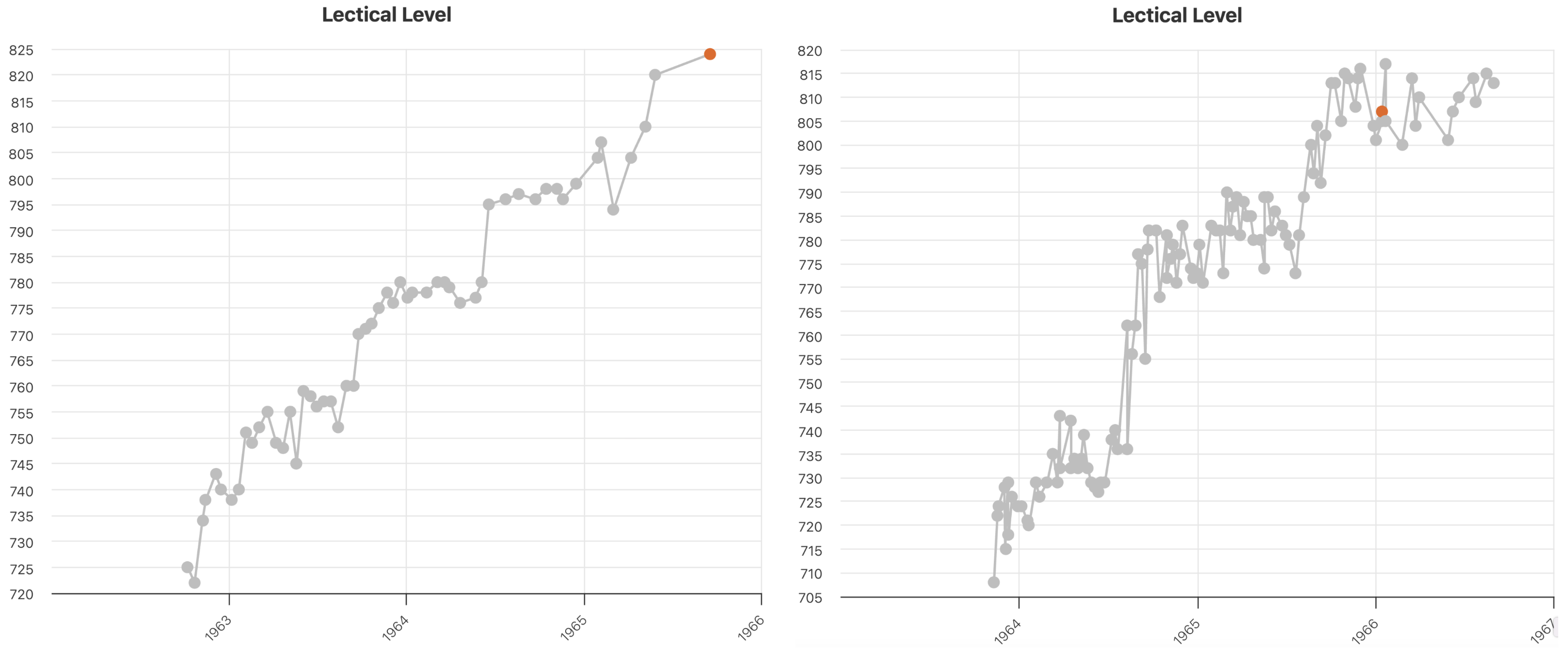
We are not expecting parents to record enough of their children's speech to produce records as dense as these. Instead, we suggest aiming for a score once every two months from ages 2–3, then once every 3 months from 4–5, every 4 months from 6–8, and every 6 months from 9-17.
Recommended minimum score and entry numbers
| Age-range | Score frequency | No. of entries | Max scores per year |
| 2-3 | Every 2 months | 4-5 | 6 |
| 4-5 | Every 3 months | 4-5 | 4 |
| 6-8 | Every 4 months | 4-5 | 3 |
| 9-17 | Every 6 months | 4-5 | 2 |
Ideal mindlogging frequency: Once children are able to make their own entries, they will benefit most from making regular weekly entries in which they write stories or reflect upon their recent learning, accomplishments, or thoughts. They will also benefit from receiving regular comments from parents and peers, and commenting on the entries of others.
MindLoggers receive more scores if the character count for the reflection entry field in MindLog is maxed out. This means it can be a good idea to keep an entry open until the character count has been met—as long as you meet the minimum score and entry guidelines in the table above. If you max out the character count for each entry, the number of entries required to receive a score will be 4-5. Entries are editable until they have been scored.
Hand writing: Because hand writing is a skill with numerous benefits for mental development, we recommend that children who are learning to write should hand write rather than type their entries. If a child is not entering responses with a writing pad (We recommend one that feels like writing on paper.), someone else can enter the responses into the current MindLog reflection field.
We can't provide maximum character counts for entries because they vary by age or educational level. The first time you use MindLog you won't know the maximum character count until you receive a warning.
Transcriptions: If you are recording text for an entry, you will most likely be able to use the built-in recording app on your phone or computer both to record and transcribe recordings. Remove all speech other than the child's, including words first spoken by others that the child repeats. Then, add the cleaned text into the currently open reflection field in MindLog. It's fine to include basic punctuation for readability if you like.
Prompt names and prompt descriptions: When naming and describing prompts, keep in mind that MindLog is an archive that will likely be visited in the future. We suggest establishing naming conventions right from the beginning. This will make it much easier to locate particular or related records in the future.
A basic three component prompt-naming convention is suggested in the "Prompt name" field. Three components, moving from the general to the particular make it easier to find similar prompts by sorting or filtering.
It may be helpful to think of the prompt fields as “topic” and “content description” fields. For example, a prompt name could be something simple like, “Pets, types, preferences” while the prompt description might be, “Why dogs are better than cats.”
See the Prompts page for more help with prompts.
Commenting: An important feature of MindLog is it's emphasis on collaborative learning through reciprocal commenting. Once children are able to write their own MindLog entries they can begin to learn how to comment on other children's entries. To learn more about commenting, check out the Commenting page.
Special guidelines for recording children's speech
You will need to record the speech of children who don't write well enough to make their own entries. Young children can be recorded at play or in conversation.
MindLog is designed to work best with spontaneously produced speech—the current everyday speech of a child. We're after what we call the child's functional vocabulary—the vocabulary in use when the child is not receiving support from the environment. Young children learn their language by repeating or “parroting” the speech the people around them. This makes it a bit challenging to collect early functional level speech.
When conversing with children who are being recorded, avoid using any language that they aren't already using on their own. Including words that are not in their active, unprompted vocabularies will artificially inflate their early scores. This can obscure later growth.
To get as close as possible to your child's functional vocabulary, follow these guidelines:
- When you're recording, avoid using words your child isn't already using on a regular basis.
- Make recordings when the child is playing with similarly-aged children or chatting with adults who understand the need to avoid using any language the child is not already using.
- After you have made a transcription of each recording, isolate your child's speech and remove all words that your child “parrots” after hearing them said by someone older.
- Next, remove all words that are not used in a meaningful way. For example, leave out words your child doesn't typically use that are repeated out of context.
Before entering a word into MindLog, ask yourself, “Is this a word that's been used by my child in everyday interactions for several days?” If the answer is “no” it's best to leave it out.
Purchasing and working with MindLog
To learn more about the mechanics of using MindLog, visit the MindLog for Educators page.
The shape of development
The approach to measurement embedded in MindLog is so new that we don't yet know for sure what growth patterns based on frequent measurements over long periods will look like. MindLog hasn't yet been around long enough to produce a single chart that covers over 15 years of MindLogging at the level of detail that MindLog makes possible. A growing number of parents, educators, researchers, and learners are looking forward to finding out!
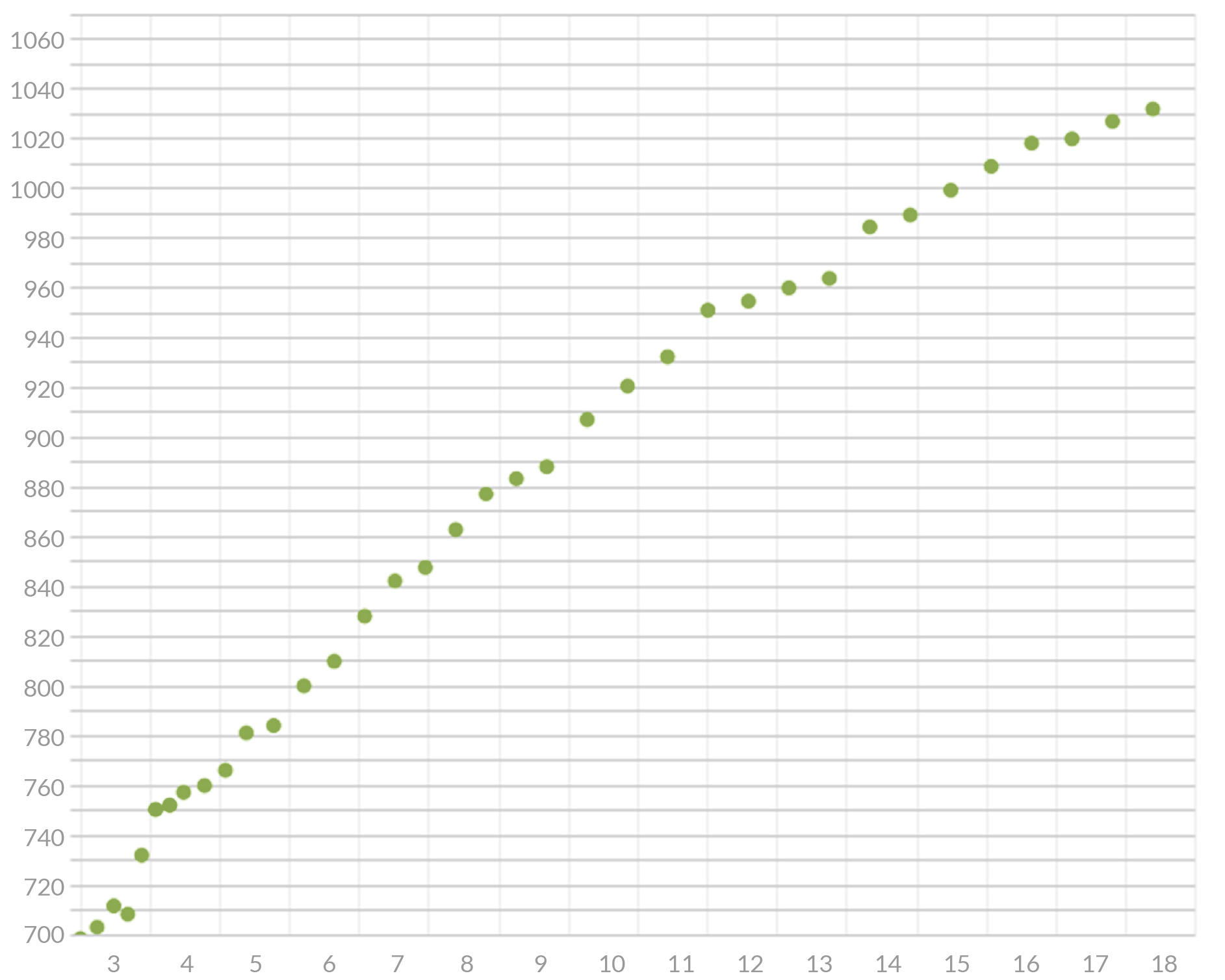
The image below shows the growth of a fictional child whose fictional parents began making entries when she was about 30 months old. Initially, speech samples were entered by her parents every few weeks until the child began entering her own responses at about age 10. This graph is based on what we already know about growth: It's bumpy, plateaus and spurts are common, and it appears to slow down with age. We say “appears to” because measurable growth at successively higher levels involves the integration of increasingly complex and abstract information, raising the question, “Is growth slowing down or just getting harder?”
A few things to consider
- Real growth can look even bumpier than what you see in the graph above. This is because so many things can affect an individual score—mood, the topic at hand, health, environmental support (like writing right after an interesting lecture), and the reason we're writing .
We expect that growth charts will reveal periods of slower growth (plateaus), followed by growth spurts. We have already documented spurts and plateaus in research with young children, as shown above in the Documenting natural speech section. It's helpful to think of plateaus as periods of consolidation (learning to work with new ideas) and spurts as periods of growth (building new ideas). If your child seems to be entering a plateau, (1) avoid introducing new challenges, and (2) make sure the child has diverse opportunities to work with current knowledge and practice existing skills. Think of plateaus as a time to deepen foundational knowledge and skills as preparation for what comes next.
It's worth it to take some time to familiarize yourself with our more general information about MindLog and optimizing learning. You will find there is much to learn here on the MindLog pages, on the Articles page, and through a little course called ViP.