
Density distribution 1
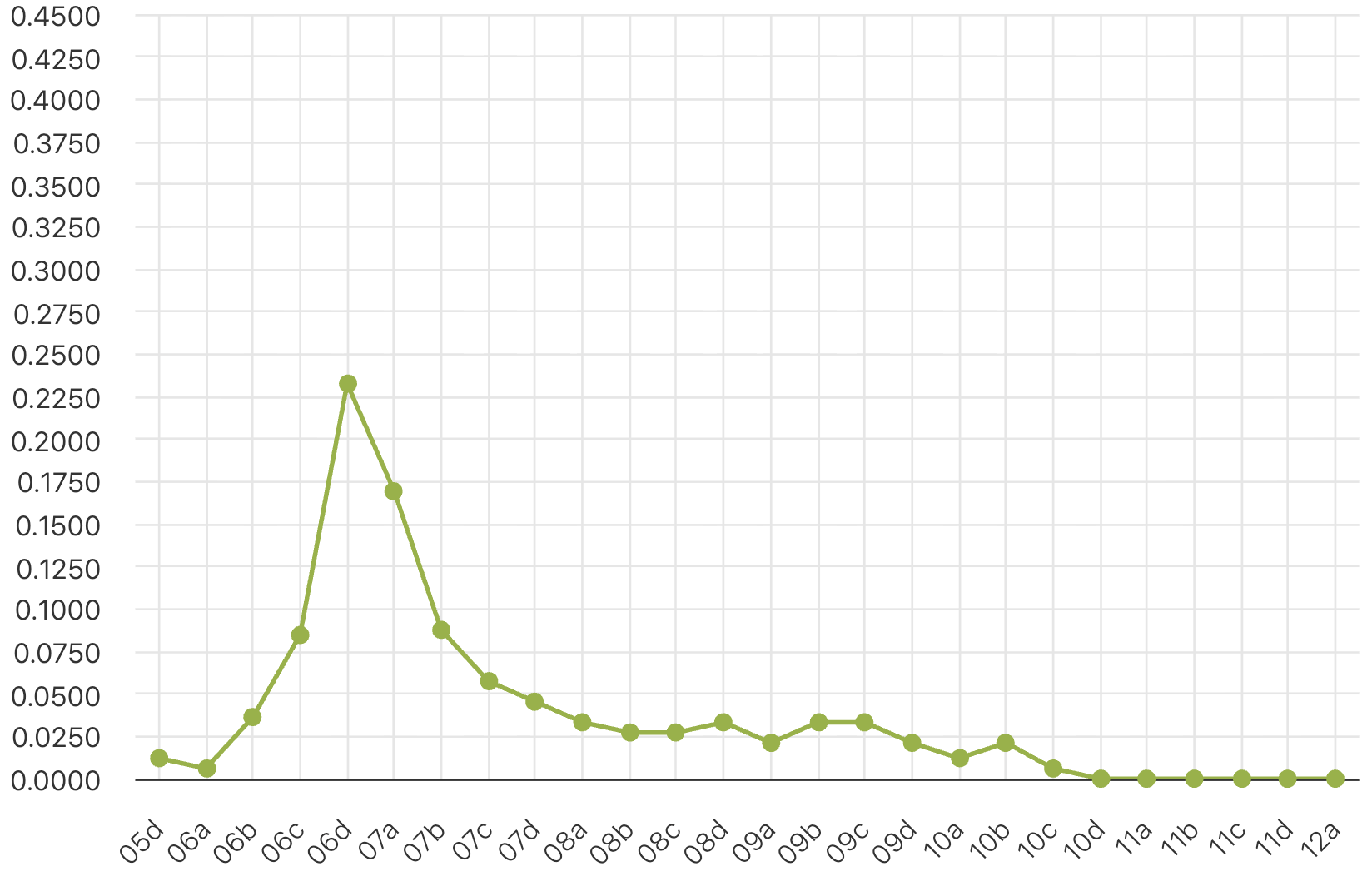
This is a typical distribution for a CLAS score of 1028, showing densities that, for the most part, gradually decline between 07c and 10b. This pattern is associated with high logical coherence and continued development in adulthood.
“They have no clue. They're just confused. They don't know what to do. Often, how I think the mind deals with confusion is like, ‘Let go of it. Forget about it for a while.’ Letting it go relaxes the mind.”
CLAS score = 1028, FIT = 92.64%, true score range = 10 points
Density distribution 2
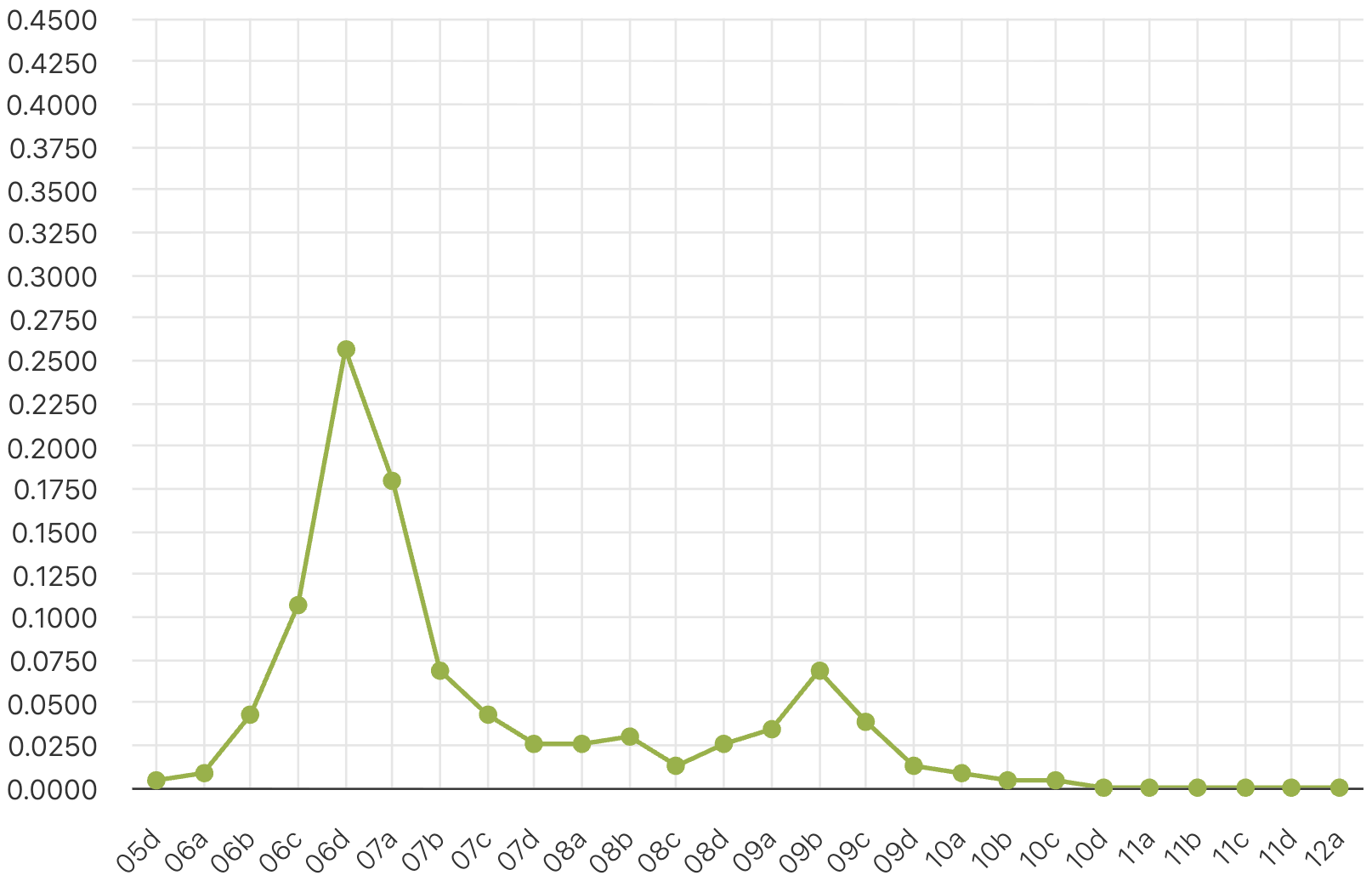
This is a typical distribution for a CLAS score of 1028, showing densities that, for the most part, gradually decline between 07c and 10b. This pattern is associated with high logical coherence and continued development in adulthood.
“I don't believe in suicide, I think it's a real coward's way out. You leave a lot of pain behind—especially if you have family—and unresolved questions, and I don't think that's appropriate.”
CLAS score = 1028, FIT = 94.95%, true score range = 10 points
Density distribution 3
This is a less typical and troubling distribution for a CLAS score of 1028, showing densities that decline between 07c and 08c, then peak strongly at 09b before sharply declining. We have dubbed this pattern memorize & forget or sacrificial learning. It is associated with rote learning, low logical coherence, and early flattening of the developmental curve.
“You can never trust information until it is solved or situated in a way you will understand. Some accusations are never correct. That's why we will never know what's real and what isn't.”
CLAS score = 1028, FIT = 88.83, true score range = 62 points
What is MindLog?
MindLog is a reliable, test-free, and content-neutral reflection and measurement system. For educational curriculum evaluators, it offers a sophisticated alternative to testing. Backed by more than 100 years of research and more than a quarter century of development, MindLog is the first tool of its kind.
How does MindLog work?
MindLog records students' written reflections in an online journal, then periodically scores them for their Lectical® Level with the Computerized Lectical Assessment System (CLAS), producing a constantly evolving developmental trajectory for each student, along with fit and health statistics.
CLAS
CLAS represents a fundamental shift in educational measurement. Unlike conventional, assessments that capture snapshots of performance within specific subject areas, CLAS functions as a universal, content-neutral “developmental ruler.”
CLAS measures the hierarchical complexity of students' written reflections on a lifespan scale. Over time, CLAS generates a continuously evolving, highly reliable personal growth trajectory for each student.
CLAS is both standardized and prescriptive.
- Standardization—CLAS matches students' written performances to a set of standardized meaning distributions.
- Prescriptiveness—The meaning distributions employed in scoring with CLAS are ideal distributions because they represent optimal patterns of mental development. They are optimal in the sense that students who consistently produce performances that fit the idealized distributions are more likely than those whose performances don't fit these distributions to be building the variety of robust meanings required for constructing increasingly complex and integrated meanings over time. Because of this, they are also more likely to continue developing throughout their lives.
For an example of how we analyze unexpected growth patterns, see Dr. Dawson's Medium article, Diagnosing learning problems with CLAS.
Why focus on mental growth?
Conventional standardized educational assessments primarily measure correctness. Scores on these tests are readily compared to the scores of other students, but they don't tell us much about the quality of students' minds, such as how skillfully they can put their knowledge to work in messy real-world contexts. They also tend to narrow the way we think about learning—the things they measure become the important things to learn. Moreover, if we look closely at tests of correctness, we find that they are highly focused on one set of mental skills—skills for remembering. Unfortunately, a strong focus on skills for remembering leaves little educational time for working on many other skills required for optimal mental development
In the mid 1990's Lectica's founder, Dr. Theo Dawson, decided that a high-quality and scalable measure of mental development would help educators strike a balance between skills for remembering and other critical life skills like those required for self-regulation, reflection, interpretation, deliberation, investigation, evaluation, social interaction, collaboration, perspective-taking, perspective-sharing, citizenship, and learning from everyday experience. She also decided that it was possible, given enough time and hard work, to develop such a measure. In the early 2000's Dawson demonstrated the feasibility of creating such a measure, then immediately began designing the research required to go from feasible to real. CLAS—the accurate, reliable, fair, standardized, prescriptive, and scalable developmental scoring system that makes MindLog possible—is the outcome of that research.
Important MindLog requirements and conventions
- MindLog is designed to measure unaided (functional level) written (or dictated) reflections. Any outside help with content, including information from any source—grammar checkers included—invalidates scores. Moreover, to reduce “parroting," prompts should always be written in the simplest possible language. (Outside help with MindLog responses is usually reflected in unexpected scores, which acts as a “cheating” deterrent.)
- There is one form of outside help that we permit. We encourage MindLoggers to use a simple spell-checker. Misspelled words can interfere with scoring.
- We place both upper and lower limitations on character count for practical purposes.
- Test-takers are the owners of their MindLog data and control over who it is shared with. (Children under the age of [TBD] are represented by their parents or guardians.)
- We place strict limits on access to MindLog responses. This provision is required to protect Lectica's IP.